Mind Middleware is a series of honest conversations with people from the tech world about the mental and emotional journey behind their careers. Hosted by Diego Nievas, in Aotearoa New Zealand.
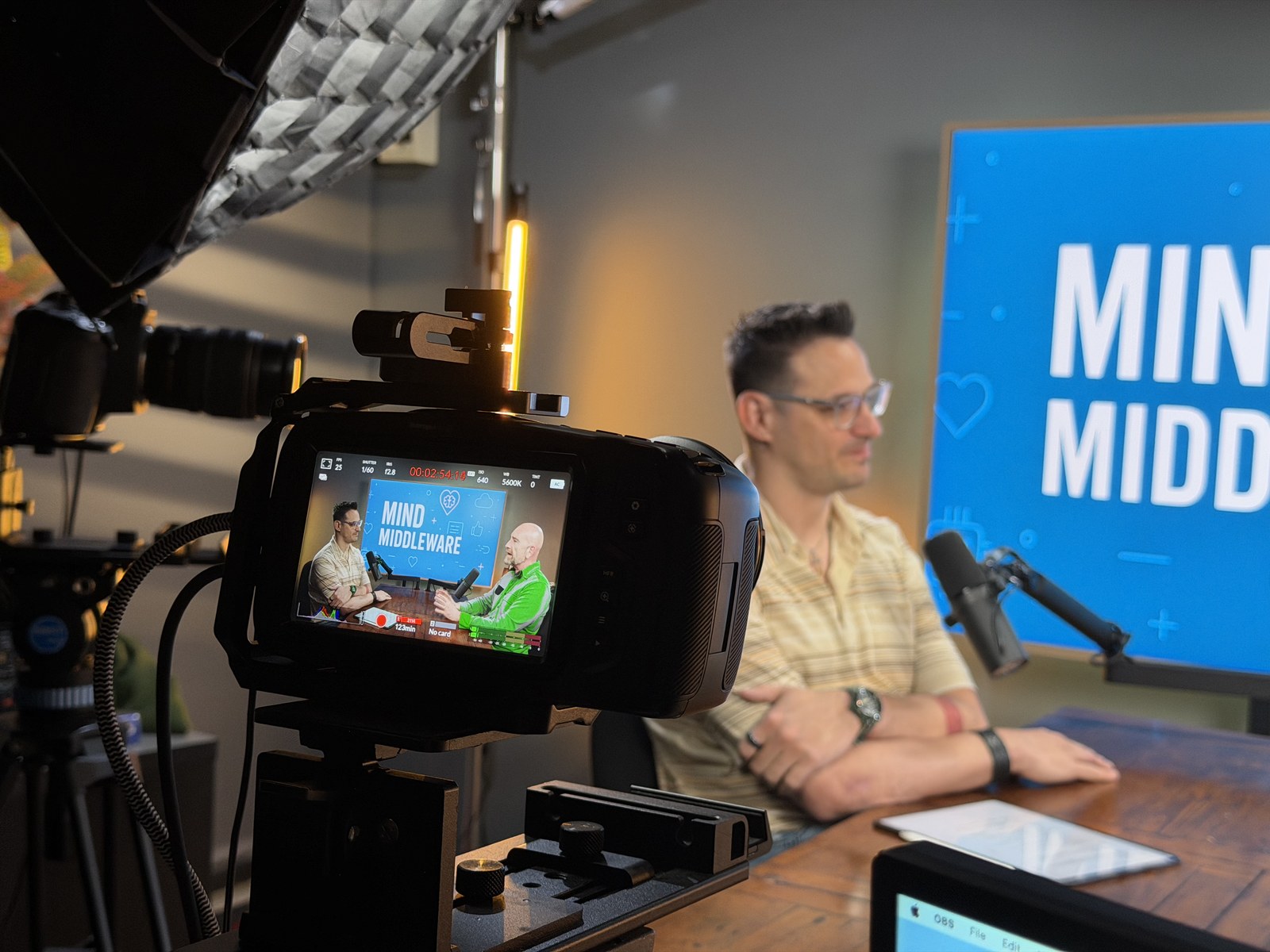
In tech, the pressure is real. Burnout. Anxiety. Isolation. The constant demand to perform takes a serious toll — and most of it happens in silence.
people die by suicide every year — one every 43 seconds.
World Health Organization · 2021 data, published 2025
of developers say they feel burnt out, at least occasionally.
Developer Nation · State of Developer Wellness, 2023 · 870 developers, 91 countries
of Australians with a mental illness see a health professional about it — fewer than half.
Australian Bureau of Statistics · National Study of Mental Health and Wellbeing, 2020–22 · Australian data
Every guest is asked the same opening question: tell me about your human doing — what you do, why you do it. Then we get to the human being underneath.
A long-time executive on the three-legged stool of health, career and relationships — and how “who are you?” became the question that broke him open. On vulnerable leadership and why the next job should scare you.
Open episodeOn choosing to be unapologetically Māori in corporate spaces, the masks we wear to survive, and a daily water ritual that resets everything. Identity, connection, and the waka as a metaphor for work.
Open episodeFifteen years in tech sales. On the physical signs of stress, being talked over as the only woman in the room, and the discipline of touching grass.
Open episodeA career as a cork on the ocean — IBM, bullying after, the psychotherapy that pulled him out, and a late-life realisation about neurodiversity. On mental fitness, the drift, and why leadership now means actually caring.
Open episodeOn ownership, whole-brain thinking, and the uncomfortable truth that the people propping everyone else up eventually collapse too.
Open episodeOn leading through COVID, becoming a Mental Health First Aider, and learning to lean into vulnerability as a leader who’d rather be tough.
Open episodeAn aeronautical engineer reinvents himself in tech, in a second country. On imposter syndrome, fingiendo demencia, and the support that gets you through twelve months of “unfortunately…”.
Open episodeA sales and technology leader on surviving a brain aneurysm, healing from an invisible disability, and the hope she now carries as a torch for others. On identity, women supporting women, and believing in people.
Open episode
Photo: Matt Kemp
I've spent the better part of two decades in tech — across engineering, sales and leadership — in Argentina, and now in Aotearoa New Zealand. I'm not a clinician. I'm not a therapist. I've said it on every episode and I'll say it here: I have no academic qualification in mental health beyond a Mental Health First Aid accreditation.
What I do have is years of being on both sides of this — the person needing help, and the person other people end up talking to. I've lived through serious depression, panic attacks, suicidal thoughts, and the slow climb back. I started Mind Middleware because the conversations I needed weren't happening loudly enough in our industry, and the ones that were happening too often stopped at "we should talk about this" without anyone doing anything.
The same conversations that happen on the podcast — translated for live audiences. For tech companies, leadership programmes, conferences, and corporate offsites in New Zealand, Australia, and remote.
The frame that runs through every episode of the podcast, built for high-performing audiences who confuse their job title with their identity. Drawn from real conversations with engineers, sales leaders, founders, and the people quietly burning out beside them.
Two talks, one day, one room: a data-led morning keynote and a personal gala piece leading into an R U OK? fundraiser, for an audience running high-paced tech-channel businesses.
For speaking enquiries, podcast guest pitches, or just to say hello — drop me a line. I read every message myself. If you're reaching out about something heavy, please also see the support resources at the bottom of this page.
 Mind Middleware